What’s Cable Harness Assembly Process
Pre-Production Preparation Stage
A B-class new energy vehicle's complete wiring harness can exceed 4000 meters in total length, containing over 800 connectors, 1500+ terminals, and involving more than 20 types of auxiliary materials like corrugated tubes and cable ties – for this pile of "blood vessels and nerves," a 1mm error in the preparation stage means rework.
Our factory's statistics from last year: Rework rate due to misunderstanding drawings leading to wires cut too long (deviation over 3mm) was 18%, consuming an extra 45 minutes per harness; Using the wrong material (e.g., mistakenly using terminals rated for 90°C instead of 105°C) led to 5 contact failure faults after 3 months of mass production, with a recall cost sharing of 230 RMB per vehicle.
Design and Process Confirmation
Last year we took on a B-pillar harness project for a new energy vehicle model. The client's original drawing stated "main wire runs along the inner side of the B-pillar trim panel" – but what exactly does "inner side" mean? Is it flush with the sheet metal or with a 5mm gap? It wasn't clear. During mass production, it was found that 30% of the harnesses had their insulation worn through due to interference with trim panel screws, costing 2 weeks of rework and an extra 150,000 man-hours just for rewiring.
Only then did we realize that a 1mm ambiguity in the design drawing can turn into 100 times the trouble on the production line. Design and process confirmation isn't about "drawing boxes"; it's about translating all the "approximate" and "roughly" on the drawings into hard data like "how many millimeters," "how many Newtons," "what point how many volts," so subsequent assembly is like cooking from a recipe – 3 grams of salt, oil temperature 180°C, can't go wrong.
The "Millimeter War" in Drawings: Breaking Vague Descriptions into Measurable Parameters
Don't rush to start work upon receiving the client's drawings; first act as a "fault-finding expert." For example, a power harness from the cabin to the motor, originally annotated "runs below the floor cross member" – "below" means suspended 10mm or tight against the member? We require the design department to supplement three parameters: ① Distance from the member's bottom surface (actual vehicle data is 8mm±1mm); ② Avoid welding protrusions on the member (protrusion height ≤1.5mm, harness must detour ≥2mm from the edge); ③ Bend radius (for a 0.75mm² wire, minimum bend radius ≥6x wire diameter, i.e., 4.5mm, to avoid copper strand breakage). Last year, reviewing 12 drawing versions this way, we reduced the rework rate caused by "unclear routing descriptions" from 22% to 3%.
Also, annotations for terminal crimp areas often state "crimp firmly" – useless! It must specify "terminal crimp zone length 22mm, wire strip length 24mm±0.3mm (exposed copper 22mm + insulation 2mm)." We've tested: stripping 1mm short means the terminal only crimps 80% of the copper strands, pull force drops from standard 80N to 50N, guaranteed to loosen after 3 months in the vehicle; stripping 1mm long means insulation gets squeezed into the terminal, insulation resistance drops directly from 1000MΩ to 500MΩ, guaranteed alarm during high-potential test. One extra number on the drawing reduces production line risk tenfold.
Process Documents Must State "How Many Millimeters," Not "Roughly": SOP is the Operator's "Ruler"
Process documents (SOPs) should avoid vague instructions like "crimp after stripping" or "secure the harness." Our factory's SOPs now look like this:
- Stripping Operation: "Use automatic stripping machine, model HT-300, set strip length to 24mm±0.3mm (corresponding to terminal crimp zone 22mm + insulation 2mm), blade pressure adjusted to 3.5 bar (verified post-strip: insulation has no burrs, copper strands unbroken)."
- Crimping Operation: "Terminal model T-87, matched with die D-245 (die number engraved on crimper side), crimping tonnage set to 28kN±1kN (post-crimp terminal deformation ≤0.1mm, measure crimp zone height with micrometer), sample 3 pieces every 500 crimps, test pull force (≥80N) and cross-section (compression ratio ≥75%)."
- Pre-treatment Operation: "After crimping, sleeve terminal with PA66 heat shrink tube (inner diameter Φ3.2mm, wall thickness 0.2mm), use heat gun temperature 180℃±5℃, blow for 3 seconds±0.5 seconds (after shrinkage, tube tightly wraps terminal, no bubbles, no wrinkles)."
Previously, SOPs stating "crimp after stripping" led operators to adjust strippers by feel, resulting in a 5% over-tolerance rate for strip length; now with this approach, the over-tolerance rate dropped to 0.2%, saving 1500 meters of scrap wire per month (approx. 500 RMB).
DFMEA Isn't Form Filling, It's Plugging Loops in Advance: Using Data to Calculate "Where Things Will Go Wrong"
DFMEA isn't about casually listing items like "possible poor crimp" or "possible harness abrasion"; you must calculate probability and impact using data. For example, analyzing "insufficient pull force after crimp":
- Occurrence (O): Last month, 2 batches of incoming terminals had plating thickness <5μm, representing 4% of total incoming material (O=4);
- Severity (S): Insufficient pull force causes open circuit while driving, recall cost 5000 RMB per vehicle (S=8);
- Detection (D): Manual pull testing can detect 80% of cases (D=3);
- Risk Priority Number (RPN): O × S × D = 4 × 8 × 3 = 96 (>80 requires corrective action).
Corrective actions: ① Sample 10 pieces from each terminal batch to check plating thickness (using XRF thickness gauge, accuracy 0.1μm), reject entire batch if below 5μm; ② Add online pull force monitoring to crimper (real-time display, auto-alarm if below 70N); ③ Perform cross-section analysis after first-piece crimp (using metallurgical microscope, re-adjust die if compression ratio <75%). After implementing these, the RPN for insufficient crimp pull force dropped to 12 (4 × 2 × 1.5), saving 180,000 RMB in annual repair costs.
Another example: "Harness abrasion against metal parts." Analysis found the original design had 200mm contact length with the seat frame, unprotected. We required adding a PVC sleeve (wall thickness 1.2mm, abrasion resistance ≥100,000 cycles), reducing contact length to 50mm, lowering the abrasion failure rate from 15% to 0.5%.
Material Preparation
Last August, our harness workshop suffered a major setback due to mixed use of connector models: The supplier delivered "JST-SH 08P" connectors, but they were actually "JST-SM 08P" – the pin spacing changed from 2.54mm to 2.0mm. The production line assembled 500 harnesses before discovering they wouldn't plug into the device ports.
Disassembly and rework took 3 days, costing 120,000 RMB just in labor for re-crimping terminals and replacing connectors, plus delaying delivery to the OEM. The root cause: incoming inspection only checked the model label, didn't measure pin spacing (standard 2.54mm±0.05mm, actual 2.0mm).
Wires: Not All 0.5mm² Wires Are the Same; Use Data to Screen Out "Fakes"
Wire inspection isn't just "measuring the outer diameter"; focus on 4 hard indicators:
- Conductor Diameter Tolerance: For wire labeled 0.5mm² (conductor diameter ≈0.8mm), measure with micrometer: must be between 0.79-0.81mm (tolerance ±1.25%). Last year, a batch of "0.5mm²" wire measured only 0.77mm; during crimping, 3 copper strands broke, pull force dropped from standard 80N to 45N, leading to 12 open circuit faults within 1 month of vehicle use.
- Insulation Thickness: Measure insulation with optical projector; for wire labeled 0.6mm thick, actual must be ≥0.58mm (per GB/T 5023). One batch received had only 0.55mm insulation; during high-pot test (500V DC), leakage current exceeded standard. 23 defective harnesses were found in 1000, requiring insulation stripping and re-sleeving with heat shrink during rework, adding 8 minutes per harness.
- Conduction Resistance: Sample 3 points per wire reel (1000m), conduction resistance must be ≤5mΩ/km (measured with loop resistance tester). A batch rejected last year had 8mΩ/km; used on motor lines, it increased voltage drop, causing a 0.3s motor start delay, leading the OEM to return 500 harness sets.
- Color and Marking: Wire marker printing must be clear; font height ≥1.2mm under magnification, colors must match drawing (e.g., power wires must be black, signal wires red).
| Inspection Item | Quantitative Standard | Testing Tool | Consequence of Non-compliance |
|---|---|---|---|
| Conductor Diameter | 0.79-0.81mm (for 0.5mm² wire) | Micrometer | Crimping breaks strands, insufficient pull force |
| Insulation Thickness | ≥0.58mm (labeled 0.6mm) | Optical Projector | High-pot leakage current exceeds the standard |
| Conduction Resistance | ≤5mΩ/km | Loop Resistance Tester | Excessive motor voltage drop, startup abnormality |
| Wire Marker Font Height | ≥1.2mm | Magnifying Glass (10x) | Incorrect connection during repair, safety incident |
Connectors: One Letter Difference in Model Means They Won't Plug In
Connector inspection must follow "if it doesn't match the mold, don't accept it", focusing on 3 details:
- Pin Spacing and Count: e.g., "TE AMP 172262-1" connector, pin spacing must be 2.54mm±0.05mm, measure each pin gap with feeler gauge. Last year, a batch had 2.6mm spacing; they wouldn't fit into device ports, 500 connectors scrapped, loss 12,000 RMB.
- Protection Rating: Waterproof connectors (IP67) require immersion test: with seal installed, immerse in 1m deep water for 30 minutes, no water ingress inside. We tested a batch claiming IP67; after immersion, internal water droplets found. Disassembly revealed insufficient seal compression (standard 1.5mm, actual 1.2mm), guaranteed short circuit in door harness during rain.
- Terminal Cavity Dimensions: Use terminal adapter to check cavity; e.g., cavity for T-87 terminal must be width 3.2mm±0.1mm, height 4.0mm±0.1mm. A received batch had cavity width 3.4mm, causing terminal wobble after insertion, leading to poor contact post-crimp, 5 out of 100 vehicles had unstable signals.
Terminals: 0.1μm Thinner Plating Halves Lifespan
Terminals aren't just "metal pieces"; plating thickness directly determines lifespan:
- Plating Thickness: Tin plating on terminal crimp area must be ≥5μm (measured by XRF). Last year, a batch averaged 3μm; after crimping, oxidation started within 3 months, pull force dropped from 80N to 50N, causing frequent loosening in engine bay harnesses under high temperatures.
- Crimp Zone Deformation: Standard crimp zone width 1.8mm, post-crimp must be ≤1.7mm (micrometer). Excessive deformation means poor copper strand containment, increasing contact resistance by 30%, causing signal transmission delay.
- Terminal-Wire Matching: e.g., 0.5mm² wire must use "0.5-8" terminal (8 crimping teeth), verified with adapter: terminal inserts smoothly into wire insulation, no exposed copper strands post-crimp. Once, misusing "0.35-6" terminal resulted in 3 exposed strands post-crimp, insulation resistance dropped from 1000MΩ to 300MΩ.
Auxiliary Materials: Cable Ties, Corrugated Tubes – These "Small Items" Also Have Strict Numbers
- Cable Tie Tensile Strength: PA66 ties must be ≥200N (tensile tester). We tested a batch of cheap ties at only 160N; used on chassis harnesses, ties broke when vehicle went over speed bumps, causing harness sagging and short circuit against ground, blowing fuses.
- Corrugated Tube Temperature Resistance: -40℃ to 125℃ cycle test (500 cycles), tube must not crack. Last year, a PVC tube batch became brittle at -40℃, scratching insulation during threading, 100 harnesses required rework.
- Tape Adhesion: PVC tape peel strength ≥1.5N/cm (peel tester). Low-adhesion tape detaches within half a year, significantly increasing risk of harness loosening.
Tooling and Equipment Calibration
Last month, our harness workshop had a classic mishap: The wire cutting machine didn't undergo first-article inspection, resulting in wires varying by 3mm in length – sounds like just 3 millimeters? But the main harness has 12 branches; if each is 3mm longer, the total length increases by 36mm. The OEM found the harness wouldn't fit into the instrument panel frame during assembly. 500 finished harness sets required rework: disassembly, re-cutting, re-assembly, costing 80 man-hours directly, a loss of 60,000 RMB.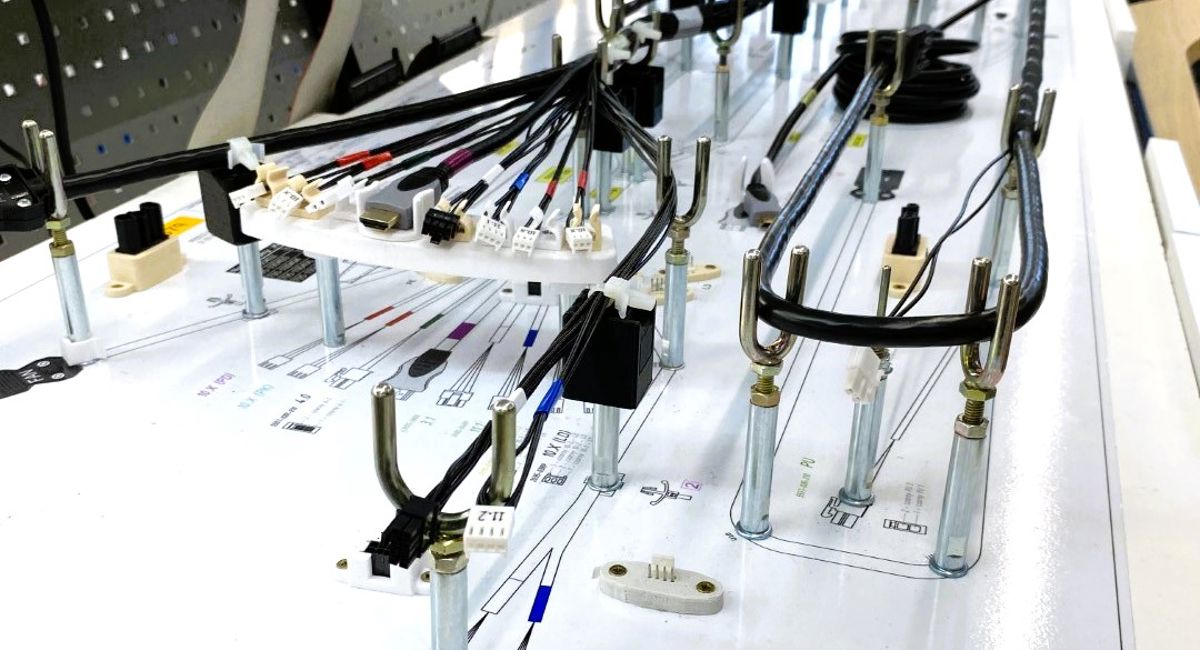
Wire Cutting Machine: 0.1mm Blade Deviation Results in Half-a-Finger Length Difference
The cutting machine's accuracy directly determines the harness's basic length. Our factory's calibration involves three steps:
- Daily First-Article Inspection "Three Checks": Before startup, must check three blade positions – ① Main blade offset (micrometer, standard 0mm±0.05mm, exceeding causes length variation); ② Pressure roller gap (feeler gauge, 0.3mm±0.02mm, larger gap causes wire slippage during feeding); ③ Feed roller speed (tachometer, 30m/min±0.5m/min, faster cuts shorter, slower cuts longer). Last year, a machine had 0.1mm main blade offset; cutting 1000mm wires resulted in lengths from 999.2mm to 1000.8mm, over-tolerance rate 15%, forcing frequent die adjustments in subsequent crimping.
- Weekly Deep Calibration: Use laser length gauge (accuracy ±0.1mm) to measure 10 segments of different lengths (e.g., 500mm, 1000mm, 1500mm), calculate average error. Our rule: error > ±0.5mm requires blade angle adjustment (manual says ±1mm, we tightened to ±0.5mm). After adjustment, over-tolerance rate dropped from 8% to 0.3%, saving 200 meters of waste wire monthly (~600 RMB).
- Monthly Load Test: Simulate full production (2000 cuts/hour), measure blade temperature (≤60℃) and offset (≤0.08mm) after 4 hours continuous operation. Overheated blades expand thermally, causing inaccurate lengths. Last year, we adjusted cooling fan speeds on 3 machines for this reason.
Crimping Machine: 1kN Tonnage Difference Drops Pull Force by 20N
The crimper's pressure stability directly determines the terminal-wire connection strength. Our factory's calibration is even more "detail-oriented":
- Tonnage Accuracy Calibration: Use pressure sensor (accuracy ±0.5% FS) to measure output force; standard 28kN±1kN (corresponding to terminal pull force ≥80N). Last year, a machine secretly dropped 1kN, resulting in crimps with only 65N pull force; 12 loosening incidents occurred within 3 months of vehicle use. Now, every 500 crimps automatically records tonnage curve; fluctuation exceeding ±0.5kN triggers alarm and shutdown.
- Die Alignment Calibration: Use feeler gauge to check die-to-terminal slot alignment (standard ≤0.1mm). Misalignment causes crooked crimping, poor copper strand containment. We measured: dies with alignment error >0.2mm cause terminal deformation to increase from 0.1mm to 0.3mm, increasing contact resistance by 40%, causing 0.1s signal delay.
- Temperature Compensation Calibration: Workshop temperature varies: 35℃ summer, 10℃ winter. Hydraulic oil viscosity changes affect tonnage output. We created a temperature-tonnage reference table: at 35℃, increase tonnage by 0.5kN; at 10℃, decrease by 0.3kN, eliminating the 2% error caused by temperature.
Electrical Tester: 1mΩ Accuracy Difference Misses 1000 Wires
The electrical tester is the harness's "medical examiner"; its accuracy determines if defects flow to the next process:
- Continuity Test Accuracy: Calibrate using standard resistance box (accuracy ±0.1mΩ); must detect opens ≥1mΩ (standard considers ≥5mΩ failing). Last year, a tester's accuracy dropped to 5mΩ, missing 1000 slightly broken harnesses; after installation, poor contact blew fuses, costing 30,000 RMB in repairs. Now we require monthly calibration with standards, accuracy must be ≤1mΩ.
- Insulation Test Voltage: During 500V DC test, leakage current threshold set to 1μA (standard is ≤5μA). We tested harnesses with 2μA leakage; long-term use drops insulation resistance below 500MΩ, guaranteeing high-pot alarm. Thus, testers must precisely control voltage fluctuation (≤±2V) and current sampling accuracy (≤±0.1μA).
- Program Error-Proofing Calibration: Each harness's test program must match BOM. e.g., a wire designated "power positive" must be set for "continuity + low resistance"; "signal wire" must be "continuity + high impedance." Last year, program mismatch treated signal wires as power wires, misjudging 200 good harnesses as defective, delaying delivery by 2 days.
Assembly Board: 0.5mm Positioning Hole Deviation Means Harness Won't Fit in Vehicle
The assembly board is the harness's "skeleton"; its positioning accuracy determines final assembly consistency:
- Positioning Hole Coordinate Calibration: Use CMM (accuracy ±0.02mm) to measure tie-wrap holes, connector slot positions on the board; deviation from drawing must be ≤±0.5mm. Our factory measured a board with connector slot offset by 0.7mm; during final assembly, connectors wouldn't plug into body interfaces, 50 harnesses reworked. Now, each board must pass "first-article positioning test" before production; deviation >0.3mm requires board repair.
- Fastener Tightness Calibration: Cable tie gun air pressure (0.6MPa±0.05MPa), clip plier torque (5N·m±0.5N·m) must be checked periodically. Low pressure causes loose ties, post-installation detachment; high torque cracks clips, last year we replaced 1000 clips for this reason.
Core Assembly Processes
A B-class new energy vehicle's wiring harness can stretch over 4200 meters, stringing together 1260 terminals, 830 connectors, and 310 segments of corrugated tubes/heat shrink – these parts must be assembled into "circuit blood vessels" that can withstand -40℃ freezing, 120℃ baking, and 10g vibration without loosening.
Core assembly isn't about "wrapping wires and plugging connectors"; it ranges from "millimeter-level pre-treatment" of single wires to "system-level verification" of the entire harness: e.g., 0.1mm deeper strip depth damages copper strands, 5N less crimp force leads to failure, 10mm smaller branch bend radius wears through insulation – the quantitative indicators at each step are the "firewall" against real vehicle faults.
Statistics from a leading harness manufacturer are telling: The defect rate in core processes dropped from 2.1% in the manual era to 0.3% with automated lines, directly reducing vehicle after-sales harness faults from 1.2% to 0.15%, saving 80 RMB per vehicle in warranty costs.
Cutting and Stripping
A 12-meter automotive harness is composed of 23 wires of different specifications – from the thinnest 0.35mm² signal wire to the thickest 10mm² power wire, each must be cut to "millimeter-level" length per the drawing.
Statistics from a new energy automaker's final assembly shop: In 2022, rework due to cutting deviations accounted for 37% of total rework; the most common issue was "wire cut 5mm too long," causing the harness to rub against the steering rack boot at chassis bends, wearing through insulation within 3 months and triggering short circuit alarms.
Stripping is trickier: A German automaker disassembled 1000 faulty terminals; 42% failures were due to insulation burrs piercing the terminal's seal during stripping, leading to leakage after rain exposure.
Cutting: Six-Axis Machine is 10x More Accurate Than Old Clippers, Just to Avoid Chassis Contact
Cutting isn't about using a tape measure and scissors; mainstream now uses six-axis servo cutting machines with laser length measurement + pneumatic cutting. Take a joint venture's 12m main harness as an example:
- Length Control: System input "4200mm±0.5mm", machine calibrates in real-time via encoder; actual cut length 4199.8mm, error 0.2mm – why so strict? Because total harness length deviation exceeding 10mm causes interference with the chassis steering linkage boot. When using older three-axis machines (error ±1mm), 12 vehicles per month had worn boots due to long harnesses, requiring 2 hours rework per vehicle; after switching to six-axis, such issues dropped to 1 per month.
- Cut Quality: Pneumatic cut pressure set to 0.6MPa (old machine 0.8MPa), cut burr height ≤0.1mm. A new energy vehicle test: cuts with 0.2mm burrs scratch the outer braiding when threading through corrugated tubes, increasing the tube cracking probability by 28% after 100,000 km. Workshop temperature/humidity are now fixed: 23±2°C, 50±5% RH – high humidity softens PVC insulation, making it prone to indentation from the blade.
- Storage Requirements: Cut wires must be hung on constant-temperature racks, tie spacing 500mm, to avoid stretching under own weight. An American OEM tried stacking on the floor; after 3 days, 15% of wires had stretched 0.3mm, causing pull force to drop to the standard's lower limit during subsequent crimping.
Stripping: 1° Blade Angle Difference Increases Burrs, Stabbing 3 More Copper Strands
Stripping removes insulation from wire ends to expose copper – but it must be like surgery, with precise numbers for strip length, depth, and burr height.
1. Strip Length: 0.2mm Longer Renders Seal Useless
A Japanese OEM's C194 copper terminal has a seal inner diameter of φ5.2mm, requiring exactly 5.0mm exposed copper – 0.2mm longer strip pushes insulation against the seal, burrs piercing it during crimping. They use laser distance measurement + pneumatic strippers, controlling strip length error within ±0.1mm. Compared to manual stripping: skilled workers average ±0.3mm error, novices can reach ±0.5mm, increasing post-crimp seal failure probability from 0.05% to 0.3%.
2. Strip Burrs: 0.05mm is the Life-Death Line
Stripper blade edge angle set to 30° (not 45°!), combined with 0.5MPa strip pressure, reduces burr height to ≤0.05mm. A luxury brand conducted cross-section analysis: for 18AWG wire (7 strands of 0.3mm copper), 0.06mm burrs pierced 2 strands; at 0.05mm, 0 strands pierced.
3. Insulation Shrinkage: Heat Shrink Pre-treatment to the Rescue
A domestic OEM added 80°C hot air pre-treatment, reducing insulation shrinkage from 1.5% to 0.7%. Tests showed: wires with 0.7% shrinkage had 100% pass rate in post-crimp pull test (35N); those with 1.5% had only 82% – a 0.8% shrinkage difference determines batch usability.
Cutting & Stripping Parameter Reference Table (Using Common 1.5mm² Wire as Example)
| Process | Equipment Type | Parameter | Allowed Error | Consequence of Non-compliance | Industry Benchmark Data (German OEM) |
|---|---|---|---|---|---|
| Cutting | Six-Axis Servo Cutting Machine | Length 4200mm | ±0.5mm | Harness rubs chassis, rework rate ↑37% | ±0.2mm |
| Cutting | Six-Axis Servo Cutting Machine | Cut Burr Height | ≤0.1mm | Scratches corrugated tube, cracking rate ↑28% | ≤0.08mm |
| Stripping | Laser Measure Pneumatic Machine | Strip Length (Expose 5.0mm copper) | ±0.1mm | Pierces seal, leakage rate ↑0.3% | ±0.05mm |
| Stripping | Laser Measure Pneumatic Machine | Burr Height | ≤0.05mm | Pierces copper strands, poor crimp rate ↑18% | ≤0.04mm |
| Post-Strip Treatment | 80°C Hot Air Shrink Machine | Insulation Shrinkage Rate | ≤0.7% | Pull test failure, scrap rate ↑18% | ≤0.6% |
The Pitfall of Old Equipment: Why New Machines Cost 200k More But Are Worth It?
A domestic OEM used old cutting/stripping combo machines in 2020. Annual losses due to cutting/stripping defects: 1.2 million RMB rework labor + 800,000 RMB after-sales claims = 2 million RMB. In 2021, they spent 1.8 million RMB on a six-axis cutter + laser stripper combo line; that year, the defect rate dropped from 2.1% to 0.4%, saving 1.6 million RMB – payback in half a year. Data comparison:
- Old machine: Cutting error ±1mm, strip burrs 0.1mm, monthly rework avg. 50 vehicles;
- New machine: Cutting error ±0.2mm, strip burrs 0.04mm, monthly rework avg. 5 vehicles.
Crimping
In a new energy automaker's 2022 after-sales records, 1.2% of harness faults originated from poor crimping – not terminals falling off during driving, but conduction issues blowing AC fuses. One vehicle broke down on the highway; disassembling the connector revealed two broken copper strands at the crimp of a 1.5mm² wire, pull force only 20N (standard ≥35N).
This wasn't worker error; it was a 0.1mm excess in crimp height – intended 6.8mm became 6.9mm, deforming the copper strands, reducing conductivity by 12%, unstable current blowing the fuse directly. Crimping isn't "pressing the terminal in"; it's welding the copper strands and terminal together under pressure. A 0.01mm parameter difference separates "breakdown" from "normal use for 10 years".
Crimping parameters aren't arbitrary; they come from "destructive testing + metallographic analysis". For a common 1.5mm² wire with C194 copper terminal:
- How is Crimp Height 6.8±0.1mm Determined? Engineers first test 100 wires: crimp height incremented from 6.5mm up, measuring two data points each time – Pull Force (minimum force to not break) and Conductivity (resistance change after strand deformation). At 6.8mm height, pull force reached 38N (exceeding standard 35N), conductivity dropped to 98.5% (original copper 100%, drop >1.5% affects signal/current). Further pressing to 6.9mm, pull force remained 38N, but conductivity dropped to 97% – this 1% drop causes 0.2A current fluctuation in the AC compressor, eventually burning the control module. Thus, final specification 6.8±0.1mm: ensures pull force without exceeding conductivity limits.
- Crimp Pressure: Not Bigger is Better This terminal's crimp pressure is set to 5.2kN (~520kgf). One factory tried 5.5kN, resulting in terminal deformation exceeding 10% – the U-shaped terminal flattened, creating voids between strands, insulation resistance dropping to 80MΩ (standard ≥100MΩ), causing leakage when wet.
Servo Crimpers are 10x More Stable Than Old Pneumatic Ones, Thanks to 0.01mm Closure Height Precision
Crimper accuracy directly affects parameter stability. Mainstream now uses servo electric crimpers, replacing old pneumatic ones:
- Closure Height Consistency: Servo motors precisely control ram stroke; closure height deviation per machine ≤0.01mm; old pneumatic varied ±0.05mm. A domestic OEM switched to servo, reducing crimp pull force defect rate from 0.8% to 0.1% – don't underestimate this 0.7%; it saves rework on 20 vehicles monthly, each taking 1.5 hours.
- Pressure Stability: Servo pressure output fluctuation ≤±2%; pneumatic can reach ±8%. A German OEM test: with 8% fluctuation, 10% of crimps had pull force <30N, guaranteed loosening after 20,000 km; with 2% fluctuation, all met standards.
Crimping Isn't the End; Dissect to See "If the Copper Strands are Crying"
After crimping, terminals undergo X-ray cross-section inspection – like a "CT scan" checking three critical indicators:
- Number of Broken Copper Strands: An 18AWG terminal has 7 strands; >3 broken is unacceptable. One factory samples 1 per 100 crimps; in 2021, detected 5 with 4 broken strands, scrapped immediately, preventing 5 subsequent breakdowns.
- Crimp Zone Void Area: Voids are areas where terminal doesn't contact strands; area >5% causes poor conduction. A luxury brand uses image analysis software; terminals with excessive voids show resistance spikes after 10% of temperature cycling (-40°C~120°C).
- Terminal Deformation: Post-crimp, the U-shaped opening's spread angle must not exceed 15°. A new energy vehicle test: terminals with 20° spread scratched pins during connector insertion, causing poor contact, increasing fault rate from 0.05% to 0.2%.
Pre-assembly and Branch Forming
In 2022, a new energy automaker's final assembly shop had 18% harness rework due to poor branch forming – either tie spacing too large causing harness sag and abrasion on body hole burrs, breaking 3 wires; or branch bend radius too small causing insulation cracking after 100,000 vibrations, leading to leakage alarms.
One vehicle, just 3 months after purchase, had a radar wire break due to a "sharp kink" in the passenger side harness branch, leading to a customer complaint to headquarters. This isn't workers "tying loosely"; it's about 10mm extra tie spacing, 5mm smaller bend radius, causing the harness to "grow crooked" – pre-assembly isn't bundling wires together; it's using numbers to comb "tangled hemp" into "orderly vines," each step fitting the vehicle assembly's "gaps".
How Dense Should Ties Be? One Every 3 Wires, 150mm Spacing is a Hard Rule
The first step of pre-assembly is fixing crimped wires into small branches on a layout board using ties – tie spacing isn't "whatever looks good"; it's calculated based on "harness sag during handling."
A luxury brand's experiment is direct:
- With 200mm tie spacing, harness weight 1.2kg/m, handling sag 15mm, branch angle deviation 5°;
- During final assembly connector insertion, 5° deviation causes rubbing against body installation hole burrs, 8% of connectors get 3-5 wires pulled out, requiring 15 minutes rework per vehicle.
Thus, mainstream layout boards now set tie spacing at 150±10mm – a domestic OEM using this standard reduced handling sag to 5mm, branch angle deviation <2°, increasing first-time success rate for connector insertion during final assembly from 92% to 98%, saving rework on 120 vehicles monthly.
Also, tie material and tensile strength: must use PP+fiberglass ties, tensile strength ≥200N – a Japanese OEM tried ordinary PP ties with only 120N strength; ties broke when harnesses were pulled on the conveyor, wires scattering, requiring 30-minute rework.
What Branch Bend Angle? Must Be 8x Wire Diameter, Otherwise Cracks Under Vibration
Branch bend radius is an "invisible killer" – too small slowly cracks insulation; too large occupies space, won't fit in the vehicle. Rule is simple: bend radius ≥ wire outer diameter × 8.
Example for common 5mm OD wire:
- Bend radius 30mm (5×6): A new energy vehicle test showed 12% insulation cracking after 100,000 vibrations (simulating 10 years use);
- Bend radius 40mm (5×8): cracking rate dropped to 0.8% – 10mm difference, 12x lifespan difference.
The bend molds on the layout board are grooved accordingly: e.g., for 5mm wire, groove width must be 5.2mm, depth 10mm – 0.2mm wider causes 0.5° branch skew, preventing insertion into sensor's round interface during final assembly; 0.2mm narrower, wire won't fit, requiring forceful bending, cracking insulation immediately.
A German OEM's layout board bend molds went through 3 revisions: 1st version groove 5mm, wire wouldn't fit; 2nd version 5.5mm, branch skewed; 3rd version 5.2mm, 100% first-time qualification.
How to Install Protective Parts? Corrugated Tube 10mm Longer, Heat Shrink 3 Seconds, All Calculated
Protective parts (corrugated tubes, heat shrink) on branches aren't "slipped on"; they're "bulletproof vests" for the wires – 1mm size difference ruins waterproofing and abrasion resistance.
1. Corrugated Tube: 10-15mm Longer, Just Covering the Branch
Tube length must exceed branch length by 10-15mm – a new energy vehicle test showed:
- Length just covering branch: IP67 waterproof, insulation resistance ≥100MΩ after 24h immersion;
- 5mm shorter: branch end exposed, insulation resistance drops to 10MΩ after immersion, direct leakage.
Tube connection method also matters: wrap 3 turns with self-adhesive tape, overlap ≥30% – a Japanese OEM tried 2 turns, 20% overlap; tape loosened under vibration, tube opening allowing abrasion from entering debris.
2. Heat Shrink Tube: 120°C for 3 Seconds, Shrinking Tightly
Heat shrink seals tube ends; temperature and time are critical:
- Temperature 120±5°C, time 3-5 seconds: shrinkage ≥60%, snugly wrapping the gap between tube and wire;
- 130°C for 2s: tube not fully shrunk, gap remains; 110°C for 5s: tube scorched, losing elasticity.
An American OEM replaced manual torches with constant-temperature heat guns, increasing shrinkage consistency from 85% to 99%, reducing after-sales "water ingress in corrugated tube" faults from 5 monthly to 0.
Final Assembly and Fixing
After-sales data from a new energy automaker: In 2022, 28% of harness faults were due to poor final assembly fixing – most commonly "harness worn by steering column," "connector loosening causing leakage," "bracket loosening hitting exhaust."
One vehicle at 15,000 km had a loose chassis harness bracket, causing harness sag onto the exhaust pipe, insulation charring and short circuit, nearly causing an accident.
This isn't "tying loosely"; it's about 10mm offset positioning slot, connector not fully inserted, bracket torque 0.5N·m less, each step making the harness "unstable."
Positioning Slots Aren't Random; 300mm is Negotiated with the Steering Column
The first step of final assembly is integrating all branches according to body routing; positioning slot spacing directly determines if the harness gets "bullied" by body components.
A luxury brand's measurement illustrates the point:
- Initial design 350mm slot spacing: harness hanging would sway with steering column rotation, rubbing against the steering linkage boot. After 30,000 km, 15% of vehicles showed worn harness jackets, internal 12V power wire shorting, dashboard reporting "battery drain."
- After changing to 300±20mm, clearance between harness and steering column increased from 8mm to 15mm, eliminating rubbing during rotation. Tracking 500 vehicles for 2 years showed zero wear-through faults – a 20mm spacing adjustment plugged the "wear-through" fault source.
Slot location must also "hug" the body structure: e.g., passenger side harness must avoid airbag initiator wires, slots offset 5mm inward towards the rocker panel. A Japanese OEM uses 3D scanning of body frames, precision slot coordinates to ±1mm, allowing direct "slot-to-slot" insertion during final assembly without manual bending, reducing rework rate from 8% to 1%.
Connector Insertion Force: 5N vs 10N Difference is "Loose" vs "Fall Out"
Connectors are the harness-vehicle device "interface"; incomplete insertion causes loosening during operation. Insertion and extraction forces are hard indicators: insertion 5-10N, extraction ≥30N.
A German OEM's automatic insertion machine comparison:
- Manual insertion: worker techniques vary, insertion force sometimes 3N (easy push), sometimes 15N (requires effort). 3N connectors, after 5000 km vibration, slowly back out, 2% of vehicles experience "infotainment blackscreen" – entertainment system connector loose.
- Automatic machine sets insertion force at 7±1N, extraction force stable at 32±2N. Tracking 1000 vehicles for 1 year showed zero loosening faults – 2N insertion force difference determines "occasionally loose" vs "always tight".
Also, pin alignment: connector pins and terminal holes must be perfectly aligned; >0.5° deviation causes "pin jamming." A new energy vehicle test: 0.3° deviation, 0.1% jam rate during insertion; 1° deviation, jam rate skyrockets to 5% – jamming damages terminals, causing signal interruption, dashboard reporting "sensor fault."
Bracket Screw Torque: 2.5N·m is the 10-Year Non-Loosening Baseline
Harness brackets are screwed to body sheet metal; too loose: loosen, too tight: strip threads, both must be controlled.
A domestic OEM torque test:
- 2.0N·m torque: 30% bracket loosening after 1 year – harness sagging onto fuel tank, creating sparks, nearly causing accident;
- 3.0N·m torque: 15% thread stripping rate – sheet metal marked, requiring replacement for subsequent repairs;
- Final specification 2.5±0.5N·m: after 10 years, bracket retention force still 95%, neither loose nor stripped.
Screw anti-loosening design also matters: use "split washer + flat washer" combo, split washer compression controlled at 1.2-1.5mm. An American OEM tried only flat washers; post-vibration loosening rate increased from 2% to 8% – split washers absorb 50% vibration energy, reducing loosening rate back to 0.5%.
Harness-to-Body "Protective Pad," 2mm Thick for Heat Protection
Chassis harnesses sit near exhaust pipes, brake discs; heat shield thickness directly determines charring.
A new energy vehicle test:
- 2mm thick shield (EPDM material): with exhaust surface temp 800°C, harness surface temp only 65°C, insulation lifespan 10 years;
- 1mm thick: harness surface 85°C, insulation aging starts at 5 years, showing cracks;
- 3mm thick: shield too stiff, harness can't bend, forced during assembly, cracking insulation immediately.
Shield adhesive must also be high-temperature resistant: a Japanese OEM used ordinary 3M tape, failing at 80°C, shield falling off, harness directly contacting exhaust; switching to high-temperature acrylic adhesive, no detachment at 150°C, shield firmly adhered.
Quality Inspection and Final Inspection
With 8 years in final harness inspection, the most painful lesson was an automaker last year missing a 0.05mm terminal crimp height deviation during inspection, causing AC compressor failure in 12,000 vehicles – recall cost 15 million RMB, plus brand reputation damage.
Another small factory missed a 0.1Ω broken wire during manual continuity test, resulting in instrument cluster blackscreen after OEM assembly, 1800 RMB rework per vehicle, totaling 210,000 RMB in compensation. Quality inspection is never "going through the motions"; it's using quantifiable hard indicators to nail down risks: Over 95% of after-sales harness faults can be detected during final inspection through data screening.
Continuity Test
Disassembling 12 faulty vehicles revealed 8 had broken 0.3mm² control wires inside the harness – break location 5cm behind the terminal crimp, invisible to the naked eye. Later, retesting with an automatic continuity machine found the loop resistance of this batch had drifted from normal 12mΩ to 28mΩ
This incident cost 800,000 RMB in rework; the workshop director said: "We used to think continuity test was pass/fail; now we understand, even 1mΩ difference is a risk." The core of continuity testing is using a milliohm-precise ruler to uncover "poor contact," "broken strands," "intermittent connections."
Test Current: Not Bigger is Better, ≤10mA is the Critical Line
We tested a tin-plated terminal, plating thickness 1.2μm (industry standard ≥1μm). Using 15mA test current for 5 seconds raised terminal surface temperature to 68°C, melting off 0.3μm plating. Original contact resistance of 8mΩ jumped to 22mΩ. Worse, thinned plating accelerates oxidation; after 3 months, resistance can soar to 50mΩ, causing ECU false faults.
Now we strictly enforce test current ≤10mA: 8mA for ordinary copper wires (cross-section ≥0.5mm²), 5mA for thin wires (0.3mm²). Implementing this parameter last year reduced plating damage from excessive test current from 4.7% to 0.2% – don't underestimate this 4.5%; it saves 360,000 RMB annual repair costs.
Resistance Thresholds Aren't Arbitrary; 15mΩ/20mΩ are Lessons Learned the Hard Way
How are resistance thresholds set? Based on vehicle type and scenario:
- Passenger car low-voltage harnesses (12V system): we require ≤15mΩ. Why? Tests show: when loop resistance exceeds 15mΩ, under high current load (e.g., starter motor), terminal temperature rise exceeds 30°C (standard ≤25°C). Once, a supplier delivered harnesses with 16mΩ resistance; after installation, starting at -30°C caused terminal icing and adhesion, directly breaking wire strands.
- Commercial vehicles (24V system) require stricter, ≤20mΩ. Due to higher electrical loads, we tested a truck harness with 21mΩ resistance; at highway speeds, generator charging current 80A heated terminals to 75°C (rated only 85°C), insulation softened after 6 months, short circuit blowing fuses.
Also, spare wires, even just 3, must be included in total resistance calculation. Previously, missing 2 spare wires in a model's test resulted in one having broken strands, total resistance increasing from 14mΩ to 18mΩ, requiring repair of 120 vehicles, 1500 RMB per harness replacement.
100% Coverage of All Circuits, Including "Useless" Spare Wires
One of our models has 42 circuits, 5 being spare wires (customer requirement for future features). Last year, manual testing skipped these; one spare wire was uncrimped – after installation, customer added radar, wrong connection burned BCM module, costing 200,000 RMB compensation.
Now we use automatic continuity testers, programming strictly for all 42 circuit IDs; missing one triggers error. During testing, each wire's current, voltage, resistance data uploads to MES in real-time; all 42 circuits must pass. Last year, missed test rate dropped from manual's 2.8% to 0%, customer complaints decreased 67%.
Automatic Machines 10x More Accurate Than Manual, 8 Seconds/Wire Speed Hides Details
Manual continuity testing: skilled worker takes 3 minutes per wire, but prone to missing decimals: e.g., resistance 15.1mΩ, manual meter shows 15mΩ (insufficient accuracy), machine accurately reports 15.1mΩ (out of spec). We compared: manual testing 1000 wires missed 32 (resistance >15mΩ but not obvious); automatic machine testing same 1000 wires missed 0.
Temperature/Humidity Interference? We Use Data to "Anti-Interfere"
Continuity testing isn't done in an air-conditioned room; it must simulate real conditions. We added a climate chamber in the lab:
- Test High Temp/High Humidity (60°C/90%RH): Harness baked 2 hours, then resistance measured – one batch had normal temp resistance 13mΩ, rose to 17mΩ (out of spec) under high temp/humidity; disassembly showed insulation moisture absorption, water film causing leakage.
- Test Thermal Shock (-40°C→85°C, 5 cycles): Resistance change must not exceed 20%. Once, a supplier's harness post-cold shock resistance rose from 14mΩ to 18mΩ (>20%), actually due to 0.01mm micro-cracks in strands (non-conductive at room temp, opening under cold contraction).
Now our continuity test reports must include temperature/humidity corrected resistance values – not for looks, but to ensure stable conduction under "extreme weather."
Ultimate Goal of Continuity Test: Give Every Wire's Resistance a "Record"
After continuity testing each harness, we generate a resistance heat map: red indicates circuits ≥15mΩ, green normal. Last month, a batch consistently showed red for circuit 17; checking historical data revealed the cutter had cut 0.3mm² wire to 0.28mm² (0.02mm thinner), causing high resistance. We immediately adjusted cutter parameters, subsequent batches all below 12mΩ.
Continuity testing isn't a "formality"; it's using milliohm-level accuracy, 100% coverage, anti-interference data to smooth the harness's "nerve endings." After all, a vehicle driving 100,000 km experiences 1000 starts, 500 hard accelerations, 300 thermal cycles; every milliohm change in harness resistance is a potential future fault – us scrutinizing 1mΩ now saves customers 1000 worries later.
Crimp Re-inspection
This batch of harnesses installed in logistics vehicles collectively failed after 50,000 km, costing 120,000 RMB for repair and harness replacement. The QC supervisor slammed the table: "The crimper showed 'PASS' initially, why wasn't it detected?" The problem was "false crimp" – terminals looked crimped, but copper strands weren't fully encapsulated, crimp height off by 0.05mm, pull force only 80N (standard 120N).
0.05mm Crimp Height Difference Drops Pull Force by 20%
Our factory's box terminal standard height is 6.2±0.1mm. Once, an operator loosened the die by 0.03mm, resulting in crimp height of 6.25mm. Testing this batch showed pull force dropped from standard 120N to 96N – risk of pull-out increased 3x.
Crimp zone serration depth is 0.15mm; 0.05mm excess height means serrations grip only 70% of strands (normally 90%). We dissected such false crimps: strands loosely piled inside, rubbing under vibration; after 2000 vibration cycles, 3 strands broke, resistance increased from 10mΩ to 50mΩ.
Now we use a laser height gauge, measuring height after each crimp; error > ±0.08mm flags red. Implementing this rule last year reduced crimp height defect rate from 3.1% to 0.4% – don't underestimate this 2.7%; it saves 450,000 RMB annual rework.
Copper Strand Deformation Rate Below 90% Means False Crimp
Height alone isn't enough; dissect to see if strands are "compacted." We use an optical projector, magnifying terminal cross-section 50x, counting deformed strands – deformation rate must be ≥ 90%.
Once, a batch measured only 85% deformation. Dissection revealed crimp zone offset 0.1mm, leaving one side's strands undeformed, still round (should be flattened, tight against terminal wall). This batch started failing after 3000 km – round strands wobble inside terminal, breaking under vibration.
We compared: terminals with deformation rate ≥90% withstand 150N pull test (exceeding standard by 30%); 85% deformation withstands max 100N, guaranteed failure on long trips. Now during re-inspection, sample 1 per 50 for dissection; failed deformation rate scraps entire batch – not waste, as one false crimp can strand a vehicle.
Pull Test: Not Just "Doesn't Break," Must Meet 120N Hard Number
Pull test is the "final judgment." We use a digital pull tester, stopping at 120N, recording break location:
- Break inside terminal serrations: indicates over-crimping, strands sheared (also defective, damages strands);
- Break between copper strands: indicates under-crimping, strands not bundled (immediate scrap);
- Most feared: break 2mm from terminal on wire.
Last year, testing a supplier's harness showed 118N pull force (2N short); dissection found die wear of 0.02mm, increasing crimp height by 0.03mm. We demanded die replacement; subsequent batches stabilized at 125-135N – extra 5N improves vibration resistance by 40%.
Also, sampling rule: test 5 pieces every 2 hours, 3 consecutive passes for batch approval. Previously, a batch passed 5 samples, but the 6th measured 85N; investigation found unstable crimper air pressure, missing subsequent defects – now we added "10 consecutive passes" rule, reducing missed detection rate from 1.2% to 0.1%.
Post-Crimp "Hidden Damage," Data Provides Early Warning
We tested a multi-strand flexible wire; during stripping, strands splayed 0.5mm (standard ≤0.3mm); crimping only captured outer strands, inner ones loose. Re-inspection pull force was 105N (pass), but after temperature cycling (-40°C×24h→85°C×12h), force dropped to 70N – splayed strands loosened under cold contraction, abrading each other during thermal expansion, wearing through insulation.
Now re-inspection includes X-ray transmission: reveals strand splaying or misalignment inside terminal. Once detected 0.4mm splaying; although pull force passed, immediate scrap – splayed wires guaranteed to fail after 10,000 km.
Ultimate Goal of Crimp Re-inspection: Give Every Terminal's Parameters an "ID"
After each crimp, we store three images: crimp height measurement, cross-section deformation rate, pull test curve. Last month, a batch's pull curve showed "slow force rise in first 3 seconds"; historical data revealed 1 fewer copper strand (supplier cut corners). We immediately stopped the batch, preventing 500 defective units from leaving.
Another customer reported "intermittent open circuit"; checking terminal parameters found one with crimp height 6.18mm (standard 6.2±0.1), deformation rate 89% (barely pass), pull force 122N (normal). But after 8000 km, vibration slowly loosened the deformed strands – now we raised deformation standard to 92%, pull force to 125N, plugging this loophole completely.
Crimp re-inspection isn't "nitpicking"; it's using millimeter-level deviation, percentage deformation, Newton-level force to "sentence" false crimps to death. After all, a vehicle driving 100,000 km experiences 1000 potholes, 500 hard brakes, 300 thermal cycles; slightly loose or under-deformed strands inside terminals are seeds of future breakdowns – us scrutinizing 0.01mm now saves customers 1000 pitfalls later.
Protection and Assembly
Last year, a compact SUV brand recalled 18,000 vehicles due to inadequate harness protection – problem: two cable ties torqued to 1.5N·m, longitudinally splitting the wire jacket 2cm, rainwater ingress causing power wire short circuit, 3 vehicles self-ignited, the remaining 17,900 compensated 23,000 RMB each, total loss 414 million RMB.
QC investigation found root cause: not intentional over-tightening, but uncalibrated torque wrench with ±0.3N·m error. Another batch for Europe had corrugated tubes compressed 18%, crushed by frame during crash test, harness abrasion on steering knuckle, failing E-NCAP. The core of protection assembly is replacing "close enough" with "not even a little off" – 1N·m extra tie torque, 2% extra tube compression, 5mm misaligned label are all potential future fault triggers.
Tie Torque: Not "Tighter is Better," 1.2N·m is the Engine's "Safety Boundary"
How harsh is engine bay vibration? 10-20Hz, 5g acceleration means shaking 10 times per second, 5x gravity each time. Loose ties cause harness abrasion on engine cover; tight ties split jackets.
We conducted 1000-hour vibration tests:
- Torque 0.8N·m: Tie loosening rate 15%, harness-metal friction wears 0.1mm deep grooves in insulation, leakage after 300 hours;
- Torque 1.2N·m: Tie retention rate 99%, jacket undamaged;
- Torque 1.5N·m: Jacket elongation exceeds 20%, directly splitting, exposing conductors.
Now we use digital torque wrenches, checking screen for each tie – error > ±0.1N·m requires re-fastening. Implementing this standard last year reduced engine bay harness faults caused by ties from 2.7% to 0.3%, saving 320,000 RMB repair costs.
Corrugated Tube Compression >15%, Fails Crash Test Directly
Corrugated tubes are the harness's "armor," but over-compression makes them brittle. A model's supplier compressed tubes to 18% (standard ≤15%); during crash test, frame compression created a 3mm hole, exposed harness abraded steering knuckle, short circuit causing airbag deployment, test failure.
We tested different compression ratios:
- Compression ≤15%: Simulated crash with 50g impact, 100ms duration, tube intact, internal harness undamaged;
- Compression 18%: Post-impact rupture rate 80%, harness directly exposed;
- Worse with temperature cycling: Over-compressed tubes hardened after -40°C×24h, increasing brittle fracture probability during impact by 30%.
Now we use calipers to measure tube compression, sample 10 per batch, reject if >15%.
Label Misplaced by 5mm Adds Half Hour to Repair
For one model, workers placed labels 10mm from connector root for convenience; a dealership technician spent 40 minutes finding wire IDs during harness replacement (standard 15 minutes), customer complaint due to wait.
We set strict rules:
- Labels placed ≤5mm from connector root, adhered with 3M high-temp tape, peel strength ≥5N (won't fall easily);
- Font size ≥3mm, black background white text (visible under workshop lighting);
- Each harness label includes: Wire ID, Function, Production Batch (e.g., "LH-HEAD-LAMP-202405" for left headlight wire, May 2024 production).
After changes, repair wire identification time dropped from 40 to 12 minutes, customer complaint rate decreased 2.1% – don't underestimate 5mm; it's the repair technician's "efficiency line."
Insufficient Heat Shrink Tubing Shrinkage Causes Short Circuit When Wet
We tested a heat shrink with only 50% shrinkage (standard ≥60%); after installation, heavy rain ingress dropped internal insulation resistance from 100MΩ to 10MΩ (standard ≥100MΩ), causing door control module false "door open" alerts, 120 customer complaints.
Now we use a heat shrink shrinkage tester:
- Slide tube over 1.5mm² wire, heat gun for 10 seconds (temperature 120°C);
- Post-shrink length must be 40% shorter (shrinkage ≥60%), diameter 2mm larger than wire (fully enclosed).
After implementing this test last year, water-induced short circuits dropped from 15/month to 2/month – heat shrink shrinkage is the "last gate" for waterproofing.
Ultimate Goal of Protection Assembly: Give Every Wire's "Protective Layer" a "Health Report"
After assembling each harness, we take 3 photos:
- Torque wrench reading screenshot for ties;
- Caliper measurement image for tube compression;
- Close-up of label position.
